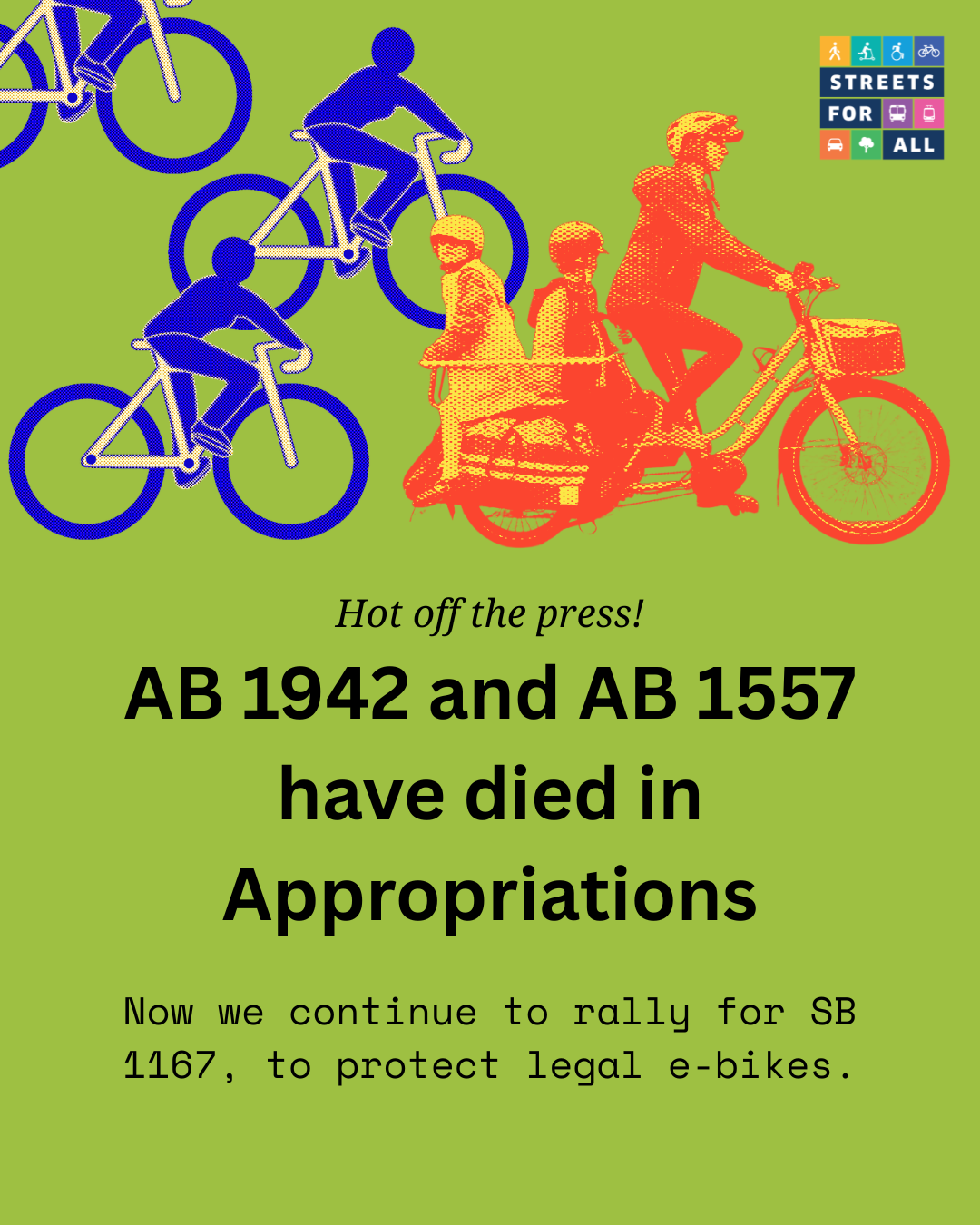
Two bills that would have been devastating to e-bike use in California died in the state legislature in May.
Your advocacy helped make it happen. Over 450 people sent letters to the legislature speaking up for reasonable e-bike regulation.
AB 1557 (Papan) would have dismantled the standard 3-class e-bike system, effectively making most existing legal e-bikes non-compliant with new bespoke manufacturing standards.
AB 1942 (Bauer-Kahan) would have required licensing and registration for e-bikes. New Jersey passed a similar law at the end of last year, and parents who bike their kids to school on class 1 e-bikes–and so many others who rely on legal e-bikes for work, transportation, or even recreation–are now facing down the reality that their bikes will be illegal to ride in a matter of weeks.
Both died in the Assembly Appropriations Committee after hundreds of you called, wrote, and lobbied your legislators. Now out of the 8 e-bike bills originally introduced this year, only four are still alive.
A few weeks ago our team went to Sacramento to build on that momentum. We met with legislators to make the case for SB 1167 (Blakespear), which would establish clear labeling requirements that distinguish legal e-bikes from illegal e-motos. We also pushed for more funding for California's Active Transportation Program and a new statewide e-bike incentive program to replace the program cut by the California Air Resources Board last year.
Here's what we're seeing: legislators want to get e-bike policy right. When they understand the real issue — that illegal e-motos, not legal e-bikes are what need regulating — most of them get it. SB 1167 already has strong bipartisan support. AB 1569 (Davies), which directs the state department of education to create a program for e-bike safety training, just passed the Assembly and is heading to the Senate.
One harmful e-bike bill is still alive and heading to the Senate. AB 2346 (Wilson) imposes new speed limits for people riding e-bikes on sidewalks and trails, directs kids under 16 to not ride faster than 15mph no matter where they are riding, creates new manufacturing standards, and establishes penalties of up to $50,000 on local bike shops for selling e-bikes without specific disclosures.
While we are supportive of the manufacturing standards in the bill, we are opposed to the speed limits. First, legal e-bikes already cannot exceed 20mph (class 1 and 2) or 28mph (class 3), so a patchwork of additional speed limits depending on context that differ from road speed limits will be difficult to enforce. Second, the bill creates potential for increased discriminatory policing, especially directed at kids.
We also oppose the penalties on local bike shops, which could be ruinous for the more than 1,000 bike shops in the state. The bill requires bike shops to provide disclosures about all of the California state regulations pertaining to e-bike operation, a resource that does not exist and would not make a meaningful impact on safety.
We are hopeful that there is a path to negotiate with the author’s office on this bill and have submitted an oppose-unless-amended letter detailing the changes we are seeking in the legislation.
Momentum is growing on the side of sensible policy for e-bikes. Amazon just announced they will stop selling high-speed devices that don’t comply with state e-bike laws in California. Attorney General Rob Bonta issued a consumer alert about high-speed devices last month. Policymakers are starting to recognize that the real problem is high-speed illegal e-motos, not legal e-bikes.
However, we expect the harmful bills to return next year. Streets For All will continue to show up in Sacramento to educate policymakers about the benefits of e-bikes and other lightweight electric micromobility, while also fighting for policy that ensures consumers are protected from unsafe devices, and vulnerable road users are protected from dangerous road conditions.