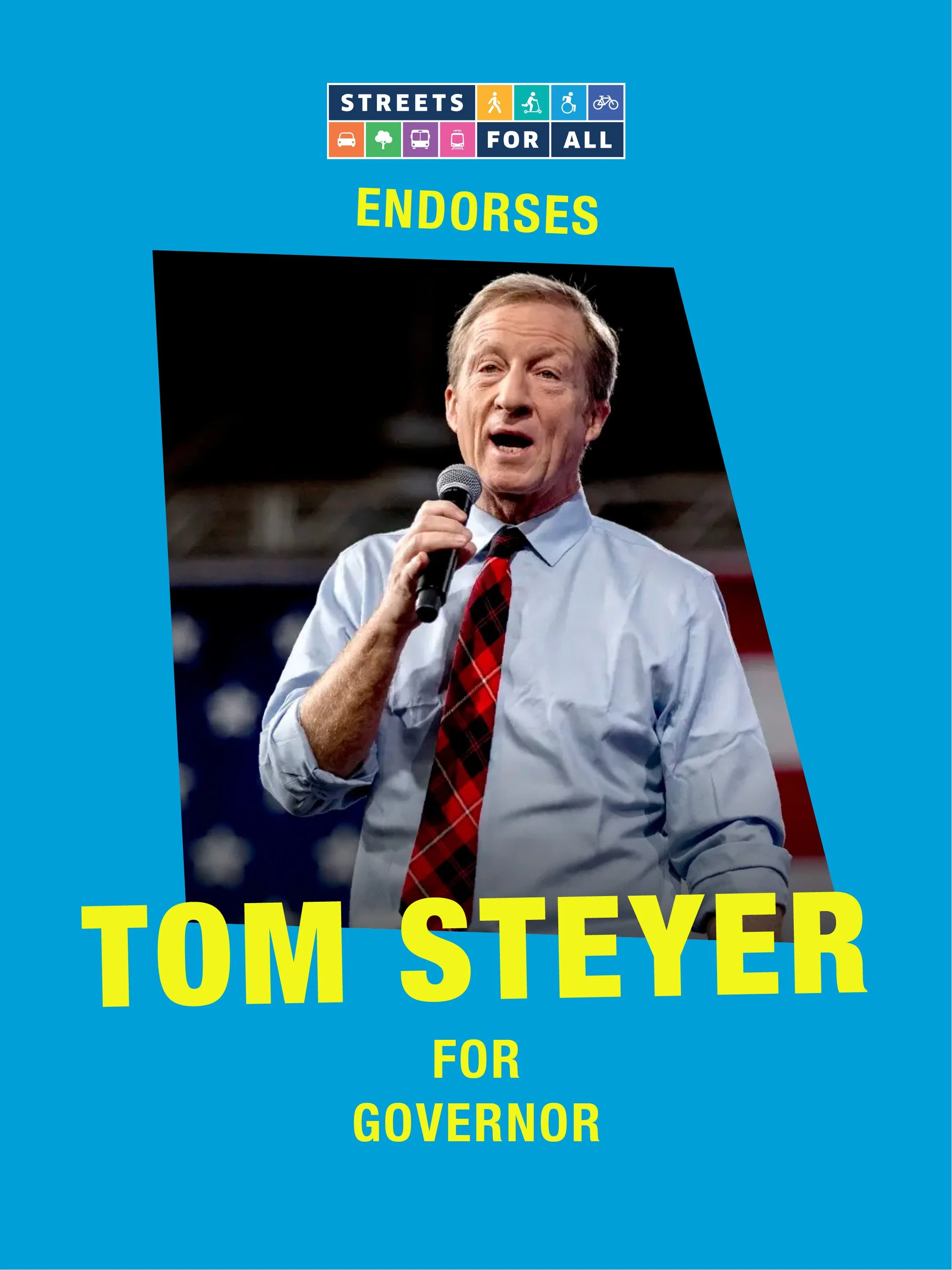
Traditionally, Streets For All sends questionnaires to campaigns and endorses based on how a candidate answers. This year, we initially decided to stay out of the Governor’s race given the wide ranging field, and therefore didn’t send questionnaires. However, given the stakes and recent changes in the race, we now see clearer differences between the leading candidates and feel the need to take a clear stand.
Below is our analysis of the top six candidates in the race, as well as our endorsement.
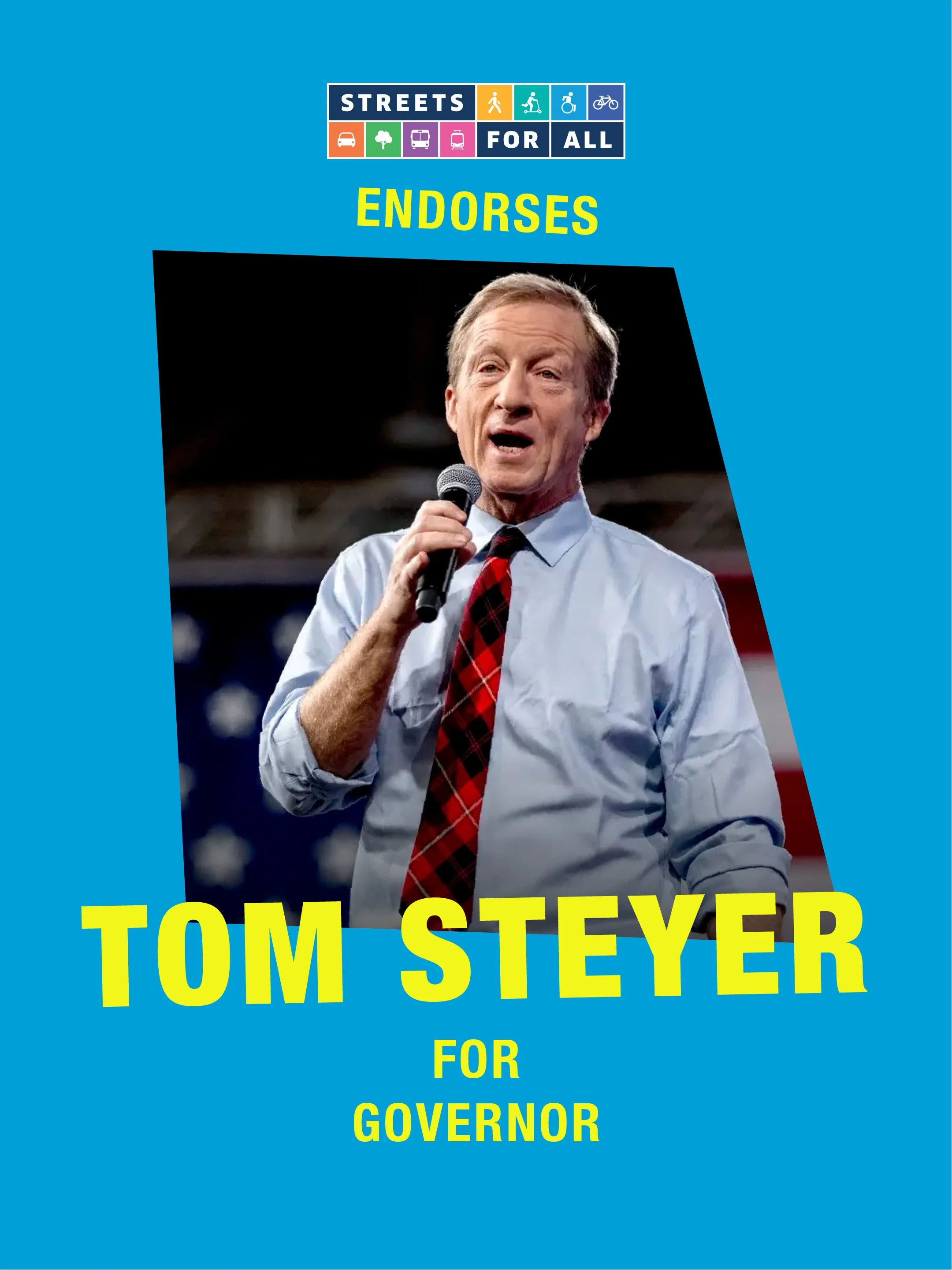
Endorsed: Tom Steyer
We believe Tom Steyer is the clearest outside reform candidate in this group. A New Yorker by birth, Steyer has lived in San Francisco for roughly 40 years, and he does not come from the normal Sacramento pipeline. Steyer is a hedge-fund founder, climate funder, ballot-measure strategist, and an abundance-aligned political organizer who has spent the last decade-plus building institutions to challenge entrenched corporate power.
We are endorsing Steyer because his stated policy values and campaign focus are most clearly aligned with Streets For All’s vision for the future of California: more efficient, affordable, and climate-friendly transportation choices, abundant and affordable housing, and cities designed to minimize car-dependency.
Steyer sees California’s challenges as the product of captured systems, bad incentives, and powerful incumbents, not as inevitable facts of life. He and his organizations appear more willing than others to name the forces blocking transformational change on transportation, housing, and infrastructure: oil companies, utilities, corporate tax beneficiaries, freeway interests, and regulatory systems that make good projects too hard and bad projects too easy.
On transportation, the strongest signal of Steyer’s record is NextGen Policy, the organization he founded and funded. NextGen has become one of California’s most important anti-highway expansion, pro-transit, pro-sustainable-transportation voices. Its work directly challenges freeway-centric transportation planning, argues that EVs alone will not solve our climate emissions from transportation, and calls for shifting money away from destructive highway expansions and towards transit and active mobility. NextGen Policy and Streets For All have been close partners for years in fights against highway expansion and for better transit.
On housing and climate, Steyer proposes building one million homes over four years, making housing “cheaper, faster, and better,” streamlining permitting, reforming zoning, enforcing state housing laws, and building dense housing near public transit. His support for SB 79 (Wiener) on transit-oriented development is meaningful; he seems to understand that housing, transportation, and climate are one connected problem, not three separate issues. Steyer has also vocally supported an effort to reform Proposition 13, and climate. His platform is not generic environmentalism; he wants to make polluters pay, defend CARB and California’s climate laws, lower electricity costs, expand clean technology, and treat decarbonization as a cost-of-living strategy.
Bottom line: Steyer is an outsider who appears willing to challenge the transportation status quo by tackling the highway lobby and fossil-fuel industry. He has a strong climate record and his takes on housing and transportation align with Streets For All’s values and policy goals.
Xavier Becerra
Xavier Becerra has spent nearly 35 years in public office or high-level public service: California Assembly, Congress, California Attorney General, and U.S. Secretary of Health and Human Services.
Becerra is campaigning on his experience in legal enforcement as California’s attorney general, implementing federal programs especially in health care, and defending existing Democratic institutions. Those instincts matter, especially under hostile federal conditions, but they are not the same as having a proactive agenda to rebuild California’s broken housing and transportation systems.
On transportation, Becerra has taken few public positions. In Congress, Becerra voted for federal infrastructure and rail and transit funding, but transportation reform does not appear to be central to his political identity. Streets For All believes that our next governor should be willing to proactively curtail highway expansion, avert transit fiscal cliffs, change the culture at Caltrans, and work to undo decades of car-centric urban planning across the state. Given his lack of public statements about climate and transportation, we do not expect Becerra to be a transformational leader.
On housing and climate, Becerra’s recent platform says many of the right things, but still reads more conventional. He acknowledges that California has not built enough homes, says housing should be treated as essential infrastructure, supports faster approvals and lower costs, and emphasizes tenant protections. As Attorney General, he also defended the Housing Accountability Act against a charter-city challenge, arguing that the state had authority to hold cities accountable for meeting housing demand. But he doesn’t appear to hold deeper values of abundance, urban growth, zoning reform, CEQA reform, transit-oriented development, or state capacity. His energy platform has a similar feel: clean energy, lower bills, utility oversight, affordability, reliability, and fairness. While these are all good policies, they are not a break from the governing consensus that produced the current system.
Bottom line: Becerra looks like a safe, experienced, status quo Democrat whose instincts are legal, federal, and one of institutions. His policy positions feel outdated; we expect him to be credible at defending existing policy, but unlikely to champion a new housing and transportation paradigm.
Katie Porter
Katie Porter is an Iowa-born bankruptcy and consumer-protection scholar, former UCI law professor, foreclosure-settlement monitor, and Orange County Congressmember whose politics are built around families being squeezed by debt, corporations, health care costs, child care costs, and housing costs.
A mom of three, she is driving her minivan across the state speaking about parents, commutes, bills, mortgage stress, and whether normal people can afford a life. She also leans heavily into national confrontation, playing up her record in Congress of taking on the Trump administration, congressional oversight, corporate cheaters, health insurers, and Big Pharma, and her whiteboard persona.
On transportation, Porter represented car-dependent Orange County and has no deep record on transit delivery, active transportation, Caltrans reform, or regional transportation governance. She has also publicly supported a project to widen the I-405, and she recently made comments against California High-Speed Rail that were later walked back. We don’t believe she would be hostile to transportation reform, but we think that real reform isn’t natural to her political instincts. Instead, she’s more likely to focus on commute affordability and household cost than mode shift, street safety, or transit-first policies.
On housing, Porter has a more progressive platform. She has become much more pro-production: her platform acknowledges that time is money, and proposes speeding up homebuilding, cutting apartment costs by 20%, enforcing housing laws, stopping local delays after entitlement, using state land and infrastructure, and building many types of housing. Her public support for SB 79 (Wiener) matters because it shows she is willing to connect housing supply with transit access and not just talk about affordability in the abstract.
On climate, Porter is more anti-corporate and consumer-focused than systems-transformational. She has come out strongly against fossil-fuel money and oil-company subsidies, but her climate politics are filtered through household fairness: who pays, who profits, who gets gouged, and who can afford the transition.
Bottom line: Porter is a serious cost-of-living candidate with a real pro-housing turn, but we are skeptical as her politics are more national, consumer-protection, and likely car-dependent suburban than deeply transportation-reform or urbanist.
Steve Hilton
Steve Hilton is the clearest ideological threat to a serious transportation, climate, and urbanist agenda in the race. London-born and Oxford-educated, Hilton is a former Conservative Party operative, former senior adviser to British Prime Minister David Cameron, former Fox News host, and Trump-endorsed Republican candidate for governor. He does not come from California local government, transportation governance, housing advocacy, environmental policy, or state legislative dealmaking. He comes from conservative media, political messaging, and a Fox News-style critique of California as a failed one-party state.
On transportation, Hilton’s agenda points in exactly the wrong direction. His campaign is built around making California “Califordable,” including a promise of $3 gas. He blames high gas prices on California’s climate agenda and has called for repealing or weakening major climate and fuel regulations, changing refinery rules, and expanding oil and gas production. That is not a transportation reform agenda; it is a cheaper-driving agenda. It accepts car dependence as inevitable and treats the problem as the price of gasoline, not the fact that California has trapped millions of people into a lifestyle of expensive, mandatory driving. Hilton has also made disparaging remarks against California High Speed Rail.
On housing and climate, Hilton appears to be more interested in housing. He talks about building more homes, reducing costs, capping fees, reforming CEQA, and speeding up construction. Some of his ideas are pro-housing, but his version appears disconnected from infill, transit, climate, and anti-sprawl principles. He has criticized density-focused housing policy and emphasized single-family homes and outward growth. His policies look to justify more sprawl, longer commutes, more driving, and less support for transit-oriented communities, with a framing that California’s climate policy is the problem, not fossil-fuel dependence.
Bottom line: Hilton is the anti-urbanist candidate — rhetorically focused on affordability and building, but instead aligned with cheap gas, fossil-fuel expansion, climate rollback, sprawl, and a transportation future that keeps Californians trapped in car dependence.
Matt Mahan
Matt Mahan is the technocratic “results” candidate in the race. He was raised in Watsonville by working-class parents, went to Harvard, and then built a career in civic-tech startups before entering local government. He served briefly on the San Jose City Council and became Mayor in 2023. His worldview is shaped less by Sacramento, labor, environmental advocacy, or transportation politics than by Silicon Valley managerialism: set metrics, use technology, cut bureaucracy, demand performance, and make government feel more like an accountable service provider.
On transportation, Mahan has operational exposure as he is a Mayor and on the VTA board. While he helped secure support from Santa Clara County to place the Connect Bay Area transit funding measure on the ballot, he has yet to publicly endorse the measure. Under Mahan, San Jose’s most distinctive transportation accomplishment was an AI-powered transit signal priority system that reportedly made buses 20% faster citywide. While this was a positive result, we did not find that he shares our broader commitment to mode shift, active transportation, transit-first governance, or ending freeway expansions.
On housing, Mahan’s platform identifies housing costs as the root of California’s affordability crisis. He has proposed a myriad of technical changes to California’s housing regulatory framework, including capping local fees, a two-year tax holiday for new construction, condo-defect liability reform, and more cost discipline for subsidized affordable housing. In his GrowSF questionnaire, he also calls for CEQA overhaul, fee caps, digital permitting, and tying state/local performance to measurable housing outcomes. Despite these pro-housing positions, Mahan did not support SB 79.
On climate, Mahan is more pragmatic than transformational. He has served on San Jose’s Clean Energy Advisory Commission and talks about clean energy innovation, storage, geothermal, grid capacity, virtual power plants, and faster permitting for clean-energy infrastructure. But his campaign also calls for suspending the state gas tax during price spikes, which would cost the state critical infrastructure funding at a time when budgets are already tight.
Bottom line: Mahan is a serious housing-process and government-performance candidate with real local executive experience, but his record and rhetoric does not give us confidence that he will prioritize transformational reform on housing and transportation in the governor’s office.
Chad Bianco
Chad Bianco is the law-and-order Republican in the race. Born at Hill Air Force Base in Utah and raised in a small mining town, he moved to California in 1989, graduated from the San Bernardino Sheriff’s Academy in 1993, and has spent more than 31 years in the Riverside County Sheriff’s Department. His worldview is shaped by law enforcement, anti-Sacramento politics, and a belief that California’s core problem is too much government.
On transportation, Bianco’s agenda is the opposite of what Streets For All wants to see in the world. His campaign calls for expanding freeways and HOV lanes, canceling California High-Speed Rail, and redirecting the remaining money to “needed infrastructure projects.” His transportation frame is congestion relief through road expansion, cheap gas, and opposition to high-speed rail.
On climate, Bianco is even more concerning. He argues that gasoline costs are the number one driver of California’s cost of living, says environmental regulations add nearly $2 per gallon, and calls for rolling those regulations back. He has explicitly called for more drilling and less reliance on imported oil, and in a recent interview said California should be “oil independent,” dismissed “green” arguments as unrealistic, and said wind and solar will not provide the electricity California needs.
On housing, Bianco has some superficially pro-production language: expedite approvals, eliminate CEQA litigation, incentivize developers, and reduce regulation. But his version of housing reform appears disconnected from infill, transit, climate, affordability requirements, or anti-sprawl principles. He emphasizes homeownership, Prop 13 protection, deregulation, and lowering costs through builder competition. That may overlap with some process-reform goals, but it does not read as a serious urbanist housing agenda.
Bottom line: Bianco is a car-dependent, fossil-fuel, freeway-expansion candidate whose housing rhetoric borrows from abundance but whose governing worldview is fundamentally anti-climate, anti-transit, anti-HSR, and hostile to the state capacity California needs.
Why these six?
Pollster Paul Mitchell’s toptwoca.com models the likelihood of a Dem vs GOP race at 95.1% based on a probability of 25,000 simulations. We therefore assessed the four most viable Democrats against the two most viable Republicans, which make up the leading six candidates according to polls.